Movements in the Crisis – Reflections on the Italian Moving
Nell’ultimo anno abbiamo assistito a una mobilitazione che non si vedeva da tempo, un muoversi a tratti impetuoso ma carsico, di sinistra ma di difficile inquadramento.
Cos’è successo?
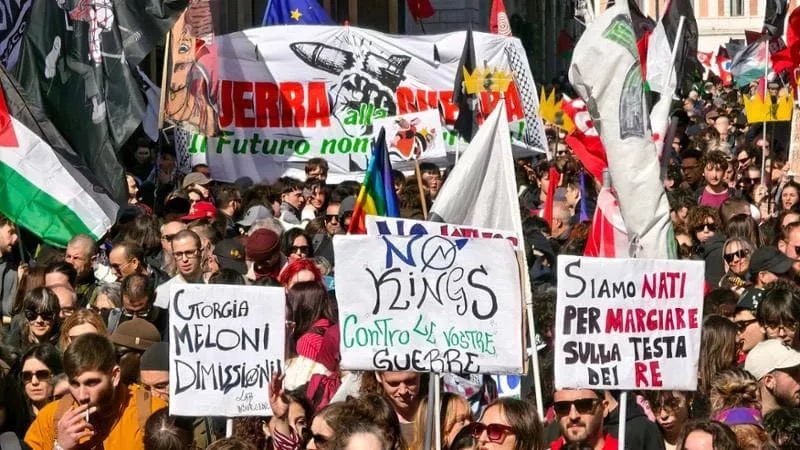
Con gli scioperi e le manifestazioni contro il genocidio in Palestina del 27 settembre e del 3/4 ottobre 2025 le piazze si sono riempite come non accadeva da un ventennio. Il 22 marzo 2026 il NO ha vinto il referendum grazie alla massiccia partecipazione di giovani e dei moltissimi voti di protesta contro il governo Meloni, anche da chi normalmente non vota. Il 28 marzo oltre 100.000 persone a Roma per l’appuntamento italiano del No Kings. Ci sono state le manifestazioni con decine di migliaia di partecipanti in difesa degli spazi sociali: Milano per il Leoncavallo il 6 settembre, Torino per Askatasuna il 31 gennaio. Non una di meno l’8 marzo ha portato in piazza decine di migliaia di persone a Roma e Milano. Vi sono stati anche momenti di protagonismo operaio: diecimila operai a Bologna il 20 giugno 2025 hanno occupato la tangenziale, gli operai Ex-Ilva di Genova in corteo hanno divelto le barriere stradali della polizia il 4 dicembre. Poi le iniziative per bloccare il transito delle armi: nell’agosto 2025 a Genova viene bloccata una nave saudita carica di materiale bellico, a settembre una massiccia manifestazione blocca l’ingresso del porto di Carrara contro il suo uso per la logistica militare; il 6 febbraio 2026 “Sciopero Internazionale dei Portuali” promosso da CALP e USB viene impedito l’attracco di navi dirette verso Israele; nella stessa giornata vi sono rallentamenti e blocchi delle operazioni di carico e scarico di materiali bellici nei porti di Livorno, Venezia e Ravenna. Manifestanti hanno occupato le stazioni ferroviarie per bloccare il transito di convogli logistici a Napoli Centrale e a Massa il 2 ottobre e a Pisa a Gennaio. Per queste azioni le segnalazioni i procedimenti da parte della Forza pubblica si contano a decine.
Cosa vogliono?
In mezzo a queste manifestazioni maggiori le iniziative particolari, nei territori, da parte delle componenti più attive. Il senso di indignazione si è diffuso e si è riconosciuto nella pratica collettiva dello scendere in piazza, in modo pacifico ma fermo. Gli scontri con le forze dell’ordine non sono visti di buon occhio, se non per autodifesa. Si tratta soprattutto di giovani, la maggior parte dei quali lavoratori e precari che appartengono alla classe. Hanno iniziato a scendere in piazza nelle manifestazioni contro il genocidio, non si riconoscono in un’unica struttura formale, ma in maniera chiara si oppongono alla guerra, alla destra razzista e alle politiche autoritarie del governo. I loro riferimenti politici sono l’antifascismo e la democrazia, il rifiuto per la guerra, sopratutto in chiave anti-USA e anti-Israele. Il tema delle condizioni di classe, lavoro, precarietà, caro-vita, tagli ai servizi… è sentito, ma per lo più a livello sindacale, non direttamente politico. Ci sembra che manchi la fiducia nella forza della classe e nella possibilità di rovesciare il sistema, così si limitano alla denuncia, rivendicando un cambio di politiche, che il potere “ritorni al popolo”. L’anticapitalismo è a volte enunciato, ma senza conseguenze.
Ascoltiamo le loro parole:
Manifesto del movimento “No Kings” Italia
“Una nuova alleanza ribelle che viene dalle città e dai territori
Una nuova alleanza ribelle contro i re del mondo, dai padroni dell’AI, ai signori degli Stati-nazione. La pace che promettono è solo dominio: ogni accordo smantella autonomia, diritti, resistenze. Il loro regime è la guerra permanente. Il futuro è davanti a noi, netto: o i re, o la libertà. Il percorso contro i re e le loro guerre iniziato il 15 Novembre 2025 a Roma e continuato a Bologna, con due giornate in cui movimenti, attivistx, reti, associazioni, campagne, realtà politiche e sindacali si sono ritrovate per affrontare le sfide del nostro tempo: dalla guerra alla svolta autoritaria e il superamento della democrazia liberale; dal nuovo sviluppo capitalistico e l’emergere di nuovi re e di nuovi sudditi, fino al domandarsi insieme quale società, quale Europa e quale mondo costruire nella Primavera che verrà.”
Le assemblee tematiche hanno affrontato i temi classici del riformismo: salario europeo, reddito incondizionato, diritto alla casa; ma anche diritto di protesta, svolta autoritaria, superamento della democrazia liberale; e resistenza alla guerra, al genocidio e alla militarizzazione.
Chi sono? I vecchi e i nuovi.
In questo contenitore confluiscono le differenti aree politiche che provengono dall’epoca pre-pandemia e le nuove leve che si sono messe in moto negli ultimi anni. Le strutture e le aree politiche del sindacalismo conflittuale come USB e SIcobas e dei centri sociali e il piccolo associazionismo di base, i social e i ragazzi.
Dalla parte istituzionale abbiamo i soliti PD, M5S, SEL, che vorrebbero capitalizzare il tutto in chiave elettorale.
Nelle mobilitazioni la forze principale è l’USB e la sua area politica che comprende anche le strutture studentesche e il partito politico potere al popolo, loro hanno perseguito con forza la causa palestinese fin da principio. Hanno promosso quasi tutti i blocchi. Ma la loro autoreferenzialità e il sentimento che prevale nel vecchio movimento di tutela esclusiva del proprio “progetto politico” e del sospetto verso tutto il resto, gli impediscono di riuscire a conquistare una partecipazione che è per lo più spontanea.
In termini più anticapitalisti è interessante citare gli accelerazionisti di sinistra, affascinati da Mark Fischer che denuncia come il meccanismo del realismo capitalista induca ad escludere la possibilità di ideare un’alternativa, purtroppo non argomenta come realizzarla, se non affermandola, immaginandola. Si tratta di un comunismo utopistico 4.0: “Settimana lavorativa di 24 ore a 1.560€ netti. Gratuità universale di casa, utenze, cibo, trasporti, sanità e istruzione. Reddito di base incondizionato di 500€, destinato a crescere con l’automazione: Ecco perché ci candidiamo al governo di questo Paese. Il comunismo di lusso non è un sogno” (Il programma del partito capibara).
Un altro aspetto degno di nota è la schiera di influencer progressisti che popolano i social, alcuni veramente bravi, da decine di migliaia di like. Denunciano Trump e Israele, con tutte le loro porcate, il governo e le sue politiche. Hanno avuto un influsso importante nello smuovere la partecipazione, il loro strumento è una narrazione quotidiana dei vari problemi all’ordine del giorno, ognuno con il suo stile e peculiarità. Quando è esplicito il riferimento di classe lo è in chiave di denuncia sindacale, quasi pietista, non di prospettiva di classe. Questi danno voce alle nuove leve con un punto di vista di sinistra, umano, di giustizia, di democrazia, rispetto dei valori antifascisti della costituzione, denuncia di tutta quest’ingiustizia, rimanendo tuttavia, per quanto criticamente, all’interno del quadro democratico.
Sulla descrizione del muoversi italiano non abbiamo molto altro da dire, questo è quello che abbiamo capito e siamo sempre aperti al confronto per sviluppare la riflessione.
Che lezioni ne traiamo
Erano vent’anni che non si vedeva una mobilitazione simile.
A suo tempo ci fu il movimento “no global” e anti-guerra, che si sviluppò a cavallo degli anni duemila e che caratterizzò con le sue tematiche gran parte delle espressioni politiche del tempo. Un movimento poi costretto a fare i conti con i suoi limiti politici e con il feroce confronto con le politiche repressive della borghesia (su tutte Genova 2001), segnando il piano inclinato del suo riflusso in gran parte in chiave elettoralistica.
Se oggi molteplici tematiche sono collegabili a quei tempi, sicuramente diversa è la condizione di fondo, la realtà sociale. È progredita la situazione di crisi permanente che avvolge ogni paese capitalistico, in cui la stessa condizione di guerra viene a pesare come aspetto essenziale nelle relazioni sociali, nei costi e sacrifici che si scaricano sulle classi subordinate.
In estrema sintesi le condizioni sono molto più dure di 25 anni fa. Questa dimensione produce in forme diverse e contraddittorie una crisi di “legittimità” costante delle classi dominanti, ma che stenta a farsi critica complessiva e di massa sul terreno più avanzato di alternativa anticapitalista. Il livello medio di coscienza del “movimento” si attesta dentro un recinto “riformista”, le sue punte avanzate cristallizzano questa prospettiva nello sbocco da dare all’agire materiale.
E’ un “riformismo” nelle sue diverse sfumature e gradazioni, reattivo e partecipativo contro gli aspetti macroscopici del degrado della situazione, verso gli spettri di guerra, e al contempo cornice entro cui si danno le rivendicazioni sul terreno delle esigenze materiali, ma che però in quanto prospettiva generale rimane un mero vuoto contenitore non idoneo ad affrontare la situazione, seppur su un terreno di legittima resistenza. E’ un “riformismo” figlio di questa situazione e sulle cui spalle e contraddizioni matura sia l’ estrema difficoltà, da parte di molti, a leggere i caratteri del “movimento” stesso, sia l’incapacità di metterlo in relazione a quello mondiale.
In conclusione
Ritornano tutti i problemi sia immediati che di prospettiva che ogni “movimento “solleva nel suo incedere, rispetto alla sua natura e agli interessi di classe che rappresenta e come li rappresenta, nel suo confronto con le politiche che mette in campo il nemico di classe, linea di demarcazione che segna il vivere o il morire di ogni prospettiva. Per quello che politicamente a noi interessa, centrali risultano quelle istanze e contenuti che pur su un terreno arretrato e come abbiamo detto reattivo, pongono al centro la “questione della guerra”. Tanto più questa diverrà, nelle sue mille forme e aspetti, il discrimine materiale della condizione di classe, tanto più si porrà l’esigenza di dare prospettiva ed organizzazione concreta alle espressioni di classe più mature. Da questa esigenza partiamo. E già da oggi, nella crisi e nella guerra, a nostro parere, il programma rivoluzionario non può che stringersi intorno alle parole d’ordine di “pace e pane”, che le classi dominanti non possono esaudire e solo l’alternativa di classe può concretizzare.
—
Ecco la traduzione letterale del testo, mantenendo la struttura originale senza sintesi o tagli.
Movements in the Crisis – Reflections on the Italian Moving
In the last year we have witnessed a mobilization that had not been seen for some time, a mild, karst-like, left-wing moving, which has expressed relevant numbers, but of difficult classification.
What happened?
With the strikes and demonstrations against the genocide in Palestine on September 27 and October 3/4, 2025, the squares filled up as had not happened for twenty years. On March 22, 2026, NO won the referendum thanks to the massive participation of young people and the many protest votes against the Meloni government, even from those who normally do not vote. On March 28, over 100,000 people in Rome for the Italian appointment of No Kings. There were demonstrations with tens of thousands of participants in defense of social spaces: Milan for Leoncavallo on September 6, Turin for Askatasuna on January 31. Non una di meno on March 8 brought tens of thousands of people to the streets in Rome and Milan. There were also moments of worker protagonism: ten thousand workers in Bologna on June 20, 2025, occupied the ring road; the Ex-Ilva workers of Genoa in a procession tore down the police road barriers on December 4. Then the initiatives to block the transit of weapons: in August 2025 in Genoa, a Saudi ship loaded with war material is blocked; in September, a massive demonstration blocks the entrance to the port of Carrara against its use for military logistics; on February 6, 2026, “International Port Workers’ Strike” promoted by CALP and USB, the docking of ships directed towards Israel is prevented; on the same day, there are slowdowns and blockages of loading and unloading operations of war materials in the ports of Livorno, Venice, and Ravenna. Protesters occupied railway stations to block the transit of logistical convoys in Naples Central and Massa on October 2 and in Pisa in January. For these actions, reports and proceedings by the Public Force number in the dozens.
What do they want?
Amidst these major demonstrations, there are particular initiatives, in the territories, by the most active components. The sense of indignation has spread and has recognized itself in the collective practice of taking to the streets, in a peaceful but firm way. Clashes with law enforcement are not viewed favorably, except for self-defense. These are mostly young people, the majority of whom are workers and precarious individuals who belong to the class. They began taking to the streets in demonstrations against the genocide; they do not recognize themselves in a single formal structure, but they clearly oppose war, the racist right, and the authoritarian policies of the government. Their political references are anti-fascism and democracy, the rejection of war, especially in an anti-USA and anti-Israel key. The theme of class conditions, work, precariousness, high cost of living, service cuts… is felt, but mostly at a trade union level, not directly political. It seems to us that there is a lack of trust in the strength of the class and in the possibility of overthrowing the system, so they limit themselves to denunciation, claiming a change in policies, that power “returns to the people.” Anti-capitalism is sometimes enunciated, but without consequences.
Let’s listen to their words:
Manifesto of the “No Kings” Italy movement
“A new rebel alliance that comes from the cities and territories. A new rebel alliance against the kings of the world, from the masters of AI to the lords of nation-states. The peace they promise is only dominance: every agreement dismantles autonomy, rights, resistances. Their regime is permanent war. The future is before us, clear: either the kings, or freedom. The path against the kings and their wars started on November 15, 2025, in Rome and continued in Bologna, with two days in which movements, activists, networks, associations, campaigns, political and union realities met to face the challenges of our time: from war to the authoritarian turn and the overcoming of liberal democracy; from new capitalist development and the emergence of new kings and new subjects, to asking together which society, which Europe, and which world to build in the coming Spring.”
The thematic assemblies addressed the classic themes of reformism: European wage, unconditional income, right to housing; but also the right to protest, authoritarian turn, overcoming liberal democracy; and resistance to war, genocide, and militarization.
Who are they? The old and the new.
In this container flow the different political areas that come from the pre-pandemic era and the new recruits who have set themselves in motion in recent years. The structures and political areas of conflictual unionism such as USB and SIcobas, and the social centers and small grassroots associations, social media, and kids.
On the institutional side, we have the usual PD, M5S, SEL, who would like to capitalize on everything in an electoral key.
In the mobilizations, the main force is the USB and its political area, which also includes student structures and the political party Potere al Popolo; they have strongly pursued the Palestinian cause from the beginning. They promoted almost all the blockades. But their self-referentiality and the feeling that prevails in the old movement of exclusive protection of one’s own “political project” and suspicion toward everything else, prevent them from succeeding in winning over a participation that is mostly spontaneous.
In more anti-capitalist terms, it is interesting to mention the left-wing accelerationists, fascinated by Mark Fisher, who denounces how the mechanism of capitalist realism induces one to exclude the possibility of devising an alternative; unfortunately, he does not argue how to realize it, if not by affirming it, imagining it. It is a utopian communism 4.0: “24-hour work week at €1,560 net. Universal free housing, utilities, food, transport, health, and education. Unconditional basic income of €500, destined to grow with automation: This is why we are running for the government of this country. Luxury communism is not a dream” (The program of the Capybara Party).
Another noteworthy aspect is the array of progressive influencers who populate social media, some truly good, with tens of thousands of likes. They denounce Trump and Israel, with all their filth, the government and its policies. They have had an important influence in stirring participation; their tool is a daily narrative of the various problems on the agenda, each with its own style and peculiarities. When the class reference is explicit, it is in the key of union denunciation, almost pietistic, not of class perspective. These give voice to the new recruits with a left-wing, human, justice, democracy point of view, respect for the anti-fascist values of the constitution, denunciation of all this injustice, remaining however, albeit critically, within the democratic framework.
On the description of the Italian moving, we have nothing much else to say.
What lessons we draw from it
It had been twenty years since such a mobilization was seen.
In its time there was the “no global” and anti-war movement, which developed around the turn of the two thousands and which characterized most of the political expressions of the time with its themes. A movement then forced to come to terms with its political limits and with the fierce confrontation with the repressive policies of the bourgeoisie (above all Genoa 2001), marking the inclined plane of its ebb largely in an electoral key.
If today multiple themes are linkable to those times, certainly different is the underlying condition, the social reality. The situation of permanent crisis that envelops every capitalist country has progressed, in which the very condition of war comes to weigh as an essential aspect in social relations, in the costs and sacrifices that are dumped onto the subordinate classes.
In extreme summary, the conditions are much harder than 25 years ago. This dimension produces in different and contradictory forms a constant crisis of “legitimacy” of the ruling classes, but which struggles to become a comprehensive and mass critique on the more advanced terrain of an anti-capitalist alternative. The average level of consciousness of the “movement” settles within a “reformist” fence; its advanced points crystallize this perspective in the outlet to be given to material action. It is a “reformism” in its various shades and gradations, reactive and participatory against the macroscopic aspects of the degradation of the situation, toward the specters of war, and at the same time a framework within which claims on the terrain of material needs are given, but which however as a general perspective remains a mere empty container not suitable for facing the situation, albeit on a terrain of legitimate resistance. It is a “reformism” daughter of this situation and on whose shoulders and contradictions matures both the extreme difficulty, by many, to read the characters of the “movement” itself, and the inability to put it in relation to the global one.
In conclusion
All the problems, both immediate and of perspective, that every “movement” raises in its progress return, with respect to its nature and the class interests it represents and how it represents them, in its confrontation with the policies put in place by the class enemy, a demarcation line that marks the life or death of every perspective. For what politically interests us, central are those instances and contents that, even on a backward and as we said reactive terrain, place the “question of war” at the center. The more this becomes, in its thousand forms and aspects, the material discriminant of the class condition, the more the need will arise to give perspective and concrete organization to the more mature class expressions. From this need we start. And already from today, in our opinion, the revolutionary program can only tighten around the slogans of “peace and bread,” which the ruling classes cannot fulfill and only the revolutionary alternative to crisis and war can make concrete.

